
Examining Current Conditions Through a Cyclical Lens
The capital cycle is governed by a simple principle: high valuations and investment returns in a particular asset class lead to an increased supply of that asset. New entrants, attracted by high returns, build properties, or start companies, or extract natural resources, or mine Bitcoin to capture the arbitrage between what it costs to create the asset, and what the asset is worth on the open market.
Eventually supply growth overshoots, and excess supply pushes investment returns below the cost of producing that asset. Then, distress and consolidation happen. Solvent companies buy insolvent companies, and liquid investors buy discounted assets from desperate, overleveraged asset owners, and from lenders who have foreclosed.
The consolidation phase is an ideal time to buy assets for two reasons. First, valuations have collapsed so assets are cheap. Second, supply growth contracts, which means demand growth will likely exceed supply growth in the near future.
Investors focus too heavily on demand without realizing that trends in supply are a fundamental driver of investment returns. Demand for an asset may be projected to increase, but if supply increases by more, values will decline.
Senior Housing: Emerging from Distress
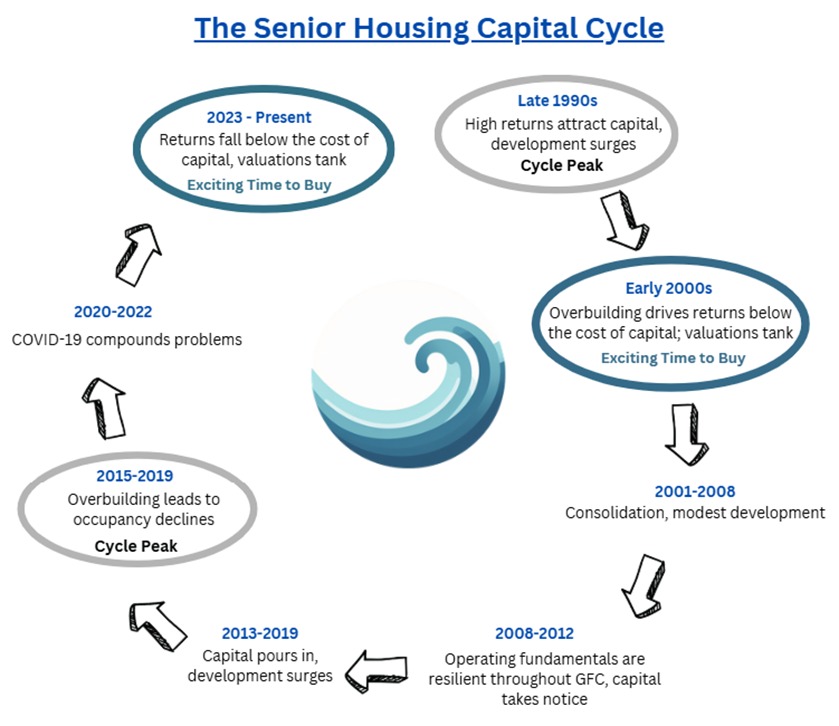
That brings us to senior housing. After a roughly 20-year roundtrip through the capital cycle, senior housing is emerging from a distress and consolidation phase. The last capital cycle went like this:
The successive blows of COVID, interest rate hikes, and raw materials inflation drove supply growth to its lowest level ever recorded. Meanwhile, occupied units are at the highest level ever recorded.
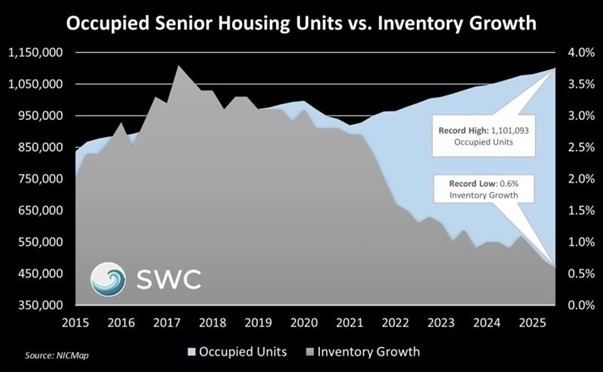
Even in a normal cycle, these would be attractive investment conditions for senior housing. The forthcoming cycle, however, will not be normal. America is in the early stages of an unprecedented demographic shift as aging baby boomers begin turning 80. Demand for senior housing is already at record highs, and the Silver Tsunami has barely landed.
The Supercycle Ahead
Valuations are low, supply growth is low, and demand growth is on the precipice of an explosion. We believe this puts senior housing in the early stages of a supercycle – a long period of sustained growth in demand, capital flows, and values that’s driven by structural forces and resistant to normal cyclical fluctuations.
We are long senior housing.
